
 Sy Shackleford
With the release of the long-awaited collaborative album by Nas and DJ Premier, there seem to be two lines of thought. The first?
Frank White: You havin’ a good time huh, Jim?
Jimmy Jump: Hey man, I been waitin’ YEARS for this!
-Nicholas St. John, King of New York (1990)
For the second?
“It ain’t ninety-fo’, Joe, we can’t go back.”
-Common, Chi City (2005)
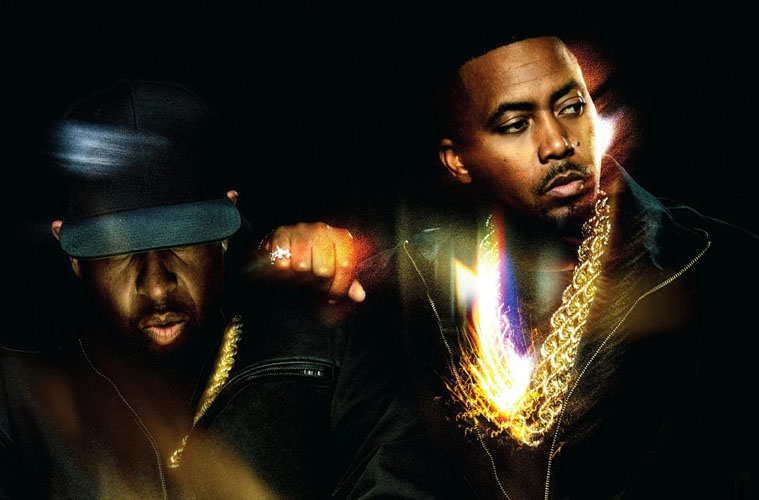
As the final release of the Mass Appeal “Legend Has It…” marketing campaign, the anticipation for this album has been building up for more than twenty years. Last year’s “Define My Name” notwithstanding, the last time Premo produced a beat for a Nas record was on the latter’s “Stillmatic” album from late 2001. Well, the wait is now over. This past Friday, the duo finally released “Light-Years”. The album title is fitting as both artists are now light years away from where they began in 1994. The release has certainly been polarizing among fans (see above). However, I will say that for anyone who was expecting another “Represent” or “DWYCK”? Sorry, this album ain’t that.
They begin with “My Life Is Real”. Over chopped piano keys, Nas big-ups several of hip-hop’s fallen soldiers and even lampshades his own involvement in the Mass Appeal album releases when he raps “Already classic before you heard it, the spoiler was all my feature verses / I lined it up kinda perfect and then I hurled it.” Premo goes skeletal on “GiT Ready”, providing a mostly simple drum & bass production. Lyrically, Nas uses double-entendres to flex his business acumen, rapping about his success in being an early investor in big businesses, dubbing himself the “Cryptocurrency Scarface”. With “NY State of Mind Pt. 3”, the production was disappointing. It begins with a sped-up vocal sample of Billy Joel’s “New York State of Mind”, but then shifts into darker, moodier loop with dusty boom-bap snares, and has a few sonic allusions to the original “NY State of Mind” on “Illmatic”. Nas, to his credit, makes reference to many current and old New York City landmarks. “Welcome to the Underground” has a menacing blues sound to it, and Nas raps about when hip-hop hit Queensbridge and how most rappers all got their start in the underground. Nas also mourns different periods of hip-hop as he raps “Epitomize, personify an open letter to multiple golden eras that ended.” On the gloomy “Madman”, Premo comes through with his classic familiar sound: Bouncy snares, record scratching, and vintage loops. Over this canvas, Nas takes aim at the current generation of rappers when he spits “You know that Metro Boomin and Future, we still don’t trust you / Didn’t start it but I boosted it, figured I’d bring it back since.”
Starting in the middle of the album, several tracks are love-letters to hip-hop. “Pause Tapes” begins with a vocal recording of Mobb Deep’s Havoc describing how he started to make beats. The track is built from a chopped keyboard sample, and Nas raps how he himself started making pause tapes while Premo incorporates sounds of actual pause tapes. “Writers” is a salute to bombers and graf writers, referencing several (Lee Quiñones, Saint, Blade, Ink, Crash, et. al.) while comparing the mics he wields as a rapper with the art tools that Graffiti writers use. Premo’s beat is very nocturnal, which works well as city bombing is done at night. At the track’s end, Nas encourages all current graf writers to keep at it. “Sons (Young Kings)” is soft in terms of production. The snares are snapping fingers and the backdrop is R&B-sounding, but Nas takes it and uses it for reflecting on sons (including his own) and what they go through. Think of it as a sequel Nas’ 2012 song “Daughters”. The Steve Miller Band is said to be featured on “It’s Time”, but Premo just reworked a sample from the band’s song “Fly Like An Eagle”. Another song that’s an example of classic Nas/Premo is “Nasty Esco Nasir”. Lyrically creative, Nas raps as himself, using three different versions of himself: Nasty Nas (from’94 and before), Nas Escobar (the start of his commercial success), and finally his present self, Nasir. Over an ominous sample, Nasir destroys his outdated variants:
As a callback to “Illmatic”, Nas brings Brooklyn’s own AZ on “My Story Your Story”. The chemistry between Nas and AZ is undeniable. Nas seems to revert to his older persona as he and AZ have a conversational rap in both verses. As a testament to Nas being a hip-hop elder statesman and his knowledge of the culture’s history, “Bouquet (To the Ladies)” is an ode to the women who are part of hip-hop (Roxanne Shanté, Queen Latifah, Eternia, Jean Grae, Lauryn Hill, Ché Noir, Salt-N-Pepa, Faith Newman, and others). The sample Premo used for this production was instantly recognizable for me as I heard it over twenty years ago on a De La Soul album. However, Premo added his own touch on it for how he flipped it. The theme on “Junkie” is comparing hip-hop to drug addiction as Nas and Premo have an all-encompassing need for it by their own admissions. Rakim and CunninLynguists have previously used this concept in “Microphone Fiend” and “My Habit (I Haven’t Changed)”, respectively. “Shine Together” ironically incorporates a line by P. Diddy from 1997’s “Victory”: “And we might as well shine together.” Lastly, “3rd Childhood” closes out the album, and is a sequel to 2001’s “2nd Childhood”, but Nas takes aim at himself this time. “Light-Years” is a good album, but not the best in Mass Appeal’s 2025 roll-out. Nas is an elite lyricist, no question. And Premo? He’s an elite producer. But for “Light-Years”, he laced several tracks that were simply “just OK.”