
 Steve 'Flash' Juon
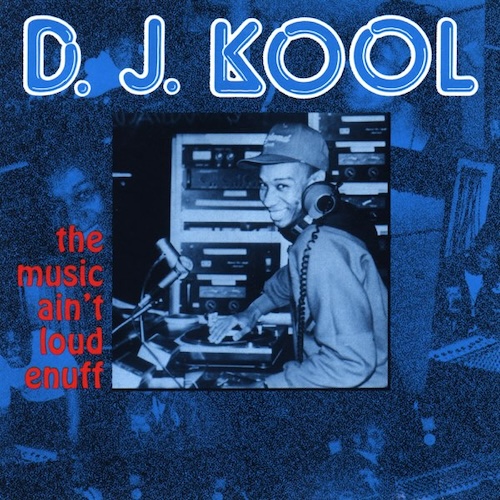
This is not the first time I’ve written about DJ Kool. I previously covered his breakout album “Let Me Clear My Throat” and wrote about how John Bowman seemingly became a sensation overnight. The emphasis belongs on the word “seemingly” because if you were from the DMV and a teenager or older in the early 1990’s, you either knew of him or had probably heard him — even if accidentally. In fact the title track of today’s review “The Music Ain’t Loud Enuff” was released as a single by Creative Funk Records back in 1988. It may not have hit nationally but it definitely hit regionally.
It’s uncanny how much Kool sounds like the late great Heavy D on this song. I can’t even call it a coincidence — it’s more like an impersonation. Parody? No. It’s not done in a mocking way. It’s just an unabashed bite of Dwight Myers stylistically. The vocal pitch, the forceful but playful delivery, the rhythm pattern of the words, it’s a dead ringer. By the time “Let Me Clear My Throat” the similarities between the two were largely gone. DJ Kool had put the “deejay” part first and the rapping a distant second, and when he did “rap” his voice was incredibly hoarse from years of live performances exhorting crowds to participate in his call and response. He sounded like a man who needed to clear his throat badly. On songs like “I Can Make You Dance” though he sounds like the Overweight Lover.
I’m not sure I can overstate this point. If anything I have to be understating it. If he didn’t keep saying things like “Making funky music is a must/DJ Kool is the name you can trust” you could convince me this was Heavy D with a blindfold on. It’s far from a bad thing. It’s delightful! It just makes me miss The Heavster that much more. MC Hammer famously said “He had a heart of gold. He was a part of what’s good about the world.” He’s right. We need more people who were as kind, loving, thoughtful and genuinely entertaining to all ages as Heavy D. There are times the later version of DJ Kool pokes through the Dwight Myers inspired flow though, such as on “How Low Can You Go.”
The raspy throat clearing Kool is definitely evident here, as is the fact he’s heavily influenced by the go-go and house music scenes that were prevalent in Washington, D.C. at the time. It’s going to be hard to split hairs about a song like “House Your Body,” an entirely unapologetic tribute to house, coming at the same time many rap groups were either begrudgingly including house songs on their albums or making fun of house altogether. DJ Kool isn’t mocking it here. It may not rival songs like “100% Pure Love” in any way but it wouldn’t be out of place in a house mix alongside it.
There are skits between almost every song on the album. Some of them are quite amusing, such as a fictitious conversation with James Brown on “Kool and the Godfather.” Some are incredibly unnecessary such as “For Rostine Only.” I mean it’s sort of funny that he tells us the next song is a tribute to his one and only love, and the next song is called “Pressed Against the Glass,” but that’s only because I thought it was going to be a Sir Mix-A-Lot style crass song. Despite the implications of the title though it’s actually a heartfelt ode bordering on corny making “I Need Love” sound like gangster rap. Not the best look for DJ Kool and not the best sample of “Do It Baby” either. (Now ask yourself, why is that?)
It’s also silly that DJ Kool felt compelled to include a “90’s Mix” of “The Music Ain’t Loud Enuff” on his album even though it really wasn’t that dated two years later. It’s true that in the era there was an unspoken war for the hearts and minds of rap listeners, and a more surly and crass hip-hop was shoving Afrocentric and conscious rap to the side, but you still had plenty of rap acts who seldom cursed or talked trash and still got respect — the late Heavy D being one such individual. Dwight Myers was proud of his Jamaican roots and it did occasionally find its way into his songs, so perhaps it’s not surprising that DJ Kool had a “Reggae Dance” on his album too, but it’s not quite as convincing.
And that’s where I suppose I have to knock DJ Kool just a little bit. If this album was a little more focused, if he spent a little more time sounding like his idol Heavy D without Ja-fake-ain the funk, if he wasn’t trying to appease listeners of every genre, this might have been a stronger album. One of the oldest cliches I know of is “when you try to please everyone you please nobody” and I think even DJ Kool knew that. He takes The JB’s “The Grunt” used in Public Enemy’s “Night of the Living Baseheads” and gives it his own party music style on “What the Hell You Come In Here For,” hammering it home with a sample of MC Ricky D (Slick Rick) and Doug E. Fresh’s “The Show” in the hook. This is his strength.
To make a long story short “The Music Ain’t Loud Enuff” can be wildly uneven at times, a little cringe at other times, but it’s not a bad record in any way. If there’s one thing I regret after hearing it, it’s that John Bowman didn’t stick to the rapping part of his shtick. I mean obviously he succeeded wildly at being the guy who could yell at a crowd and get them to yell back in response and made fat bank off of it, but as an emcee he wasn’t that bad. He’d be too PG for the present day, but by the standards of the 1990 he was doing just fine.