
 Damien Holsters
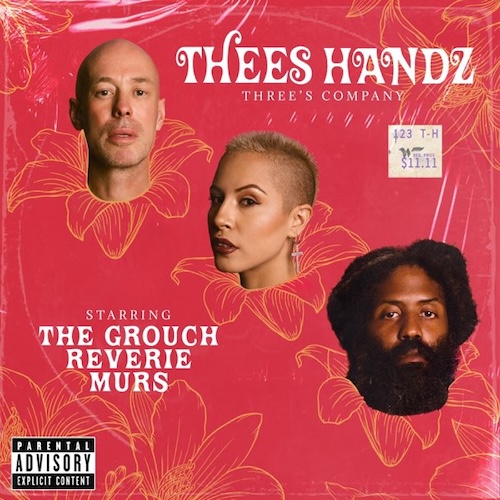
Following a successful cameo in the first season of Thees Handz (episode 1: “Carpe Diem”), Murs & Grouch were clever to grant Reverie a leading role in the second one. Apologies for the facile metaphor: the title of this project, as well as its sitcom-like skits – whether it’s the boys complaining about her never keeping the toilet seat up, or schooling her raunchy ass for feeling entitled to sex after two dates (his body, his choice, Rev!) – put it right in front of me. Mind you, a Three’s Company remake featuring this cast of characters would definitely deserve to go past the pilot.
Not least because the chemistry between Murs and Reverie was evident dating back as early as their first collab in 2013. A few years later, her guest verse on Captain California’s “One Uh Those Days” was easily the most well-suited for the album. But if her addition to this project is so refreshing, it’s not only in the formal contrast her quicker delivery or higher-pitched singing adds: she also brings balance content-wise, as her sassy bravado accentuates the boys’ casual one. “I’m old school but I spit like a young’n” Murs had previously claimed on “RWTFYA”. But in showing more than enough youthful ardor and raw emotion for the whole record, Rev allows him and Grouch to safely switch lanes into a lyrical subgenre they, alongside Slug and a few others, are peerless at: dad rap.
In concrete terms, this means they’re grown men who don’t have to worry about impressing anyone anymore. (The album’s only backseat-bars song, “SZA”, might be its less interesting). Their goal isn’t to take-over the game no more, but to live out their peculiar family life to the fullest, driving the kids to soccer practice one day, and hitting the studio the next. They both display a sense of peace, one that Rev seems to still be striving for: while their temperament remains equable throughout, hers fluctuates, from semi-laid-back hostility (“Hate behind my back then you smile in my face/ Stupid bitch you gon’ get slapped so watch what you say”) to confessional pathos (“It’s easy hiding tears drowning in a ocean/(…) I be going through a lot but I don’t show it”).
The opening track, out of which this last excerpt is taken from, highlights this discrepancy in a subtle way, and demonstrates the kind of attention to detail Grouch has as a beatmaker. Not that this borderline chillout instrumental wasn’t already complex enough ; yet, notice how he added specific backing sounds for each verse: synthwavey notes for himself, a kind of reversed synth for Murs. But Reverie, on the other hand, gets a salient electric guitar riff, one that complements her more intense lyrics perfectly (“I ain’t ever gonna get to go back in time/ If I could, then I would’ve stopped a suicide”). On this song and throughout, the fifteen-year age gap between the performers is hence highlighted, and utilized as a strength. And although it often allows them to go on their own separate subplots, there are still enough similarities between the three MC’s that an overarching narrative is preserved.
Chief among those similarities is their inability to keep it in their pants. It may be inevitable when you’re from the land of the three Ws. (To paraphrase Kendrick: if you want to discuss your love for lust, just make sure you visit there first). Their open, mature take on sexuality is actually one of the main assets of this project. The transition from Rev’s more sultry lyrics to the guys’ and vice versa is never awkward, and it never feels like they’re trying to out-lewd each other: on the opposite, their crude, horny exuberance only makes their platonic cross-sex camaraderie look more healthy. Those obsessed with asymmetrical power dynamics will have no bone to chew on here, as they all have a field day spicing it up. Lines like Rev’s “Papi, everything I say, I mean it/ Want you to fuck me till I’m screamin’” are simple, but punctuated with a mariachi-style grito, they’re particularly effective. As for the guys, as oxymoronic as it may sound, they even pull off what you could call sexy dad rap. That’s especially true for Murs:
“Never was a pretty boy, had-to-lick-the-kitty boy
Now it’s like I need it, I eat it because it gives me joy
Titty boy, two chains on the bed frame
Hope you don’t mind that I play these kind of head games” (“Sweet N Fine”)
or
“Stuck up in the house, so we fuckin’ on the couch
Kids be up at 6 a.m., ain’t no fucking going out” (“To Live and Drive in LA”)
And then of course, there’s the literal common ground between them: California (Oakland for Grouch, LA for Murs and Rev). In a West Coast rap scene often flooded with posing, their depiction of life in the golden state is a buoy of candor and authenticity; a love letter to siestas, self-love and small friend circles, but one you can’t stamp as hollow hipsterism. (In fact, making fun of “ego-friendly” hipsters has long been a trademark of underground hip hop in LA and the Bay, with the trio’s sarcastic wit on “Spiritual Gangster” a throwback to Living Legend’s “Artsy”.) The Bear Flag is waved by occasional bites of Spanglish from Rev (sorry Murs but “Yo soy mejor en la planeta” is not standard Spanish grammar) and shout-outs to Souls of Mischief or Steph Curry. And while their portrayal is colorful, it’s never rose-colored:
“In the Bay we don’t be stuck-up, we be friendly, we be open
But leave something in the whip and it’s gonna get stolen” (Grouch, “Where I’m From”)
As such, while this is not the kind of project that has singles – it’s the kind that doesn’t even have a Discogs page – if it did, “Where I’m From” and “To Live and Drive in LA” would certainly be frontrunners. Grouch’s lingering beats, Murs’ dad rap realism, Rev’s Snow Tha Product-like energy: when it all comes together, the results are perfect examples of what underground-style Cali anthems should be. Ask yourself: who else but Murs could’ve have pondered if “the fast life [is] really worth the gas price” ? In one metaphor, expertly laid out in a single internal-rhyming line, he weaves together the allure of the City of Angels and the daily concerns of its inhabitants ; he speaks simultaneously as the rapper and as the common man. And that may be the point. By the end of the album, Grouch’s mention of “pimps and players amidst gents and saviors” sounds less a like claim about the Bay demographic, and more like a description of the split-personalities of, possibly, the three finest raconteurs of everyday California life.