
 Grant Jones
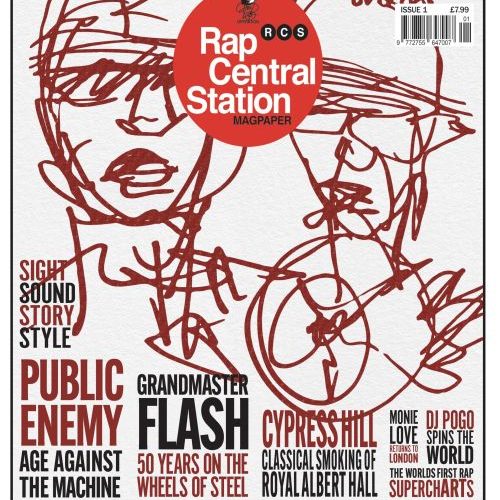
Hanging around in a train station is one of life’s overlooked joys, especially if you like people-watching. Inevitable delays often prolong this activity, and there’s a reason why newsagents continue to operate out of them rather than in the high streets. Books and magazines are ideal ways of passing the time, and usually more nourishing than an overpriced coffee or greasy burger, so it was a pleasant surprise during the work commute to spot a new Hip-Hop magazine on the shelves at London Paddington’s cosy corner that is WHSmiths. I say cosy, it’s not, there’s no doors for a start, but that’s besides the point – it’s cosy compared to the rest of the place, scattered with tourists and busy bodies going about their day. The magazine in question is called Rap Central Station, as if it knows that this is going to be picked up at train stations across the country. In fact, it’s a publication that is available globally, backed by Public Enemy’s Chuck D as an alternative to the current Hip-Hop media landscape that is dominated by digital outlets shilling celebrity culture and celebrating everything except the culture and music.
It’s an admirable venture, with the first issue presented in a square 12″ by 12″ format to mirror the vinyl records that inspired its birth. Structurally, there’s a healthy smattering of interviews, reviews and advertisements, although I found it started to run out of steam halfway through. Journalist Kyle Eustice shines with her interview pieces, chatting to Grandmaster Flash, Mix Master Mike and Big Daddy Kane. There are some brief histories of The Legendary Twin Towers and The Disco Twins. There’s a must-read interview with DJ Pogo. These are all gold, and ironically, it’s the writing that doesn’t bang on about Chuck D that justifies the price tag (£7.99). You see, PE’s main man has his finger in so many pies that 90% of this magazine is him and his connections promoting one of SpitSLAM Record Label Group (his record label), MadUrgency (his creative collective), RapStation (his radio station), Bring the Noise (his app), his new album, his recent tour, his new film, his new book. It’s all a bit much.
The “Singles” section is clearly written with AI (no writers are credited); these are the final paragraphs of each review:
Memphis Jelks feat. Chuck D :: We Built This City
“We Built This City doesn’t just play through speakers; it stands tall, like a monument to hustle, heritage and home.”
Mykill Miers :: America the Beautiful???
“With America the Beautiful???, Mykill Miers doesn’t just drop a single – he delivers a sermon, a challenge, and a reminder that real patriotism means never being silent. “
Khujo Goodie :: Pray For Me
“Pray For Me isn’t just another track – it’s a continuation of the Goodie Mob legacy: Southern grit, spiritual depth, and the kind of truth-telling hip-hop needs right now.”
Khujo Goodie :: Urban Warfare
“Khujo doesn’t chase trends here; he defines them. Urban Warfare isn’t just a track – it’s testimony.”
This is some bullshit and needs to be called out. Chuck D’s notes as Editor, a shotgun blast of musings that sometimes provoke thought (“people barely flinch at the miraculous”), sometimes try to be too clever (“art is short for artificial”), but ultimately follow the theme of distrust and fear of AI and tech, ring hollow. Unbelievably, in amongst all the RapStation adverts, there’s the announcement on page 55 of “the world’s first AI music station”. Chuck D is the last person I expected to be embracing AI.
Probably the most interesting experiment featured is the record review section. Rappers such as Monie Love, Skyzoo and Wise Intelligent review their own LPs. None of the albums covered contains a single piece of criticism, so all read more like promotional material. If everything is great, nothing is great.
Formatting and typos rear their ugly head halfway through the mag, which is a shame. The profile piece on April Walker doesn’t even mention her name. I quite like the middle 16-page slog with radio charts, as it might be useful for anyone looking for music to listen to, especially younger readers. Praise has to be directed toward the inclusion of articles on breakdancing, graffiti and DJing. Particularly, the piece with Jonzi D – writing about dance is a hard sell compared to the visual delights of graffiti and photography.
Rap Central Station is of interest to any Hip-Hop fan, but be wary of the heavy-handed adulation aimed at Chuck D throughout – it just didn’t feel necessary. If you’re interested in Hip-Hop, specifically the period that’s covered and fawned over here, you know who Chuck D is and what he means. I’m curious if future issues rectify this (and the AI nonsense), as the premise is good, but the execution is frustrating. There is definitely a gap in the market, and they have identified the 50+ market as one that grew up on Public Enemy as the core readership, but it can sometimes read like old men banging on about how things were better in their day. When talking about new music, it’s described with language that means very little, often using AI tropes. The material I enjoyed and found valuable was the interviews with artists, clearly written by a human, as they felt genuine and professional. Much of the content seemed to come with a caveat of promoting one of Chuck’s crew’s artistic ventures, which reads as insincere, even if the thing is funded and heavily reliant on the Chuck D connection. Rap magazines often came with the caveat of having to ignore the noise, but Rap Central Station seems not just to bring the noise, it often gets drowned in it.